
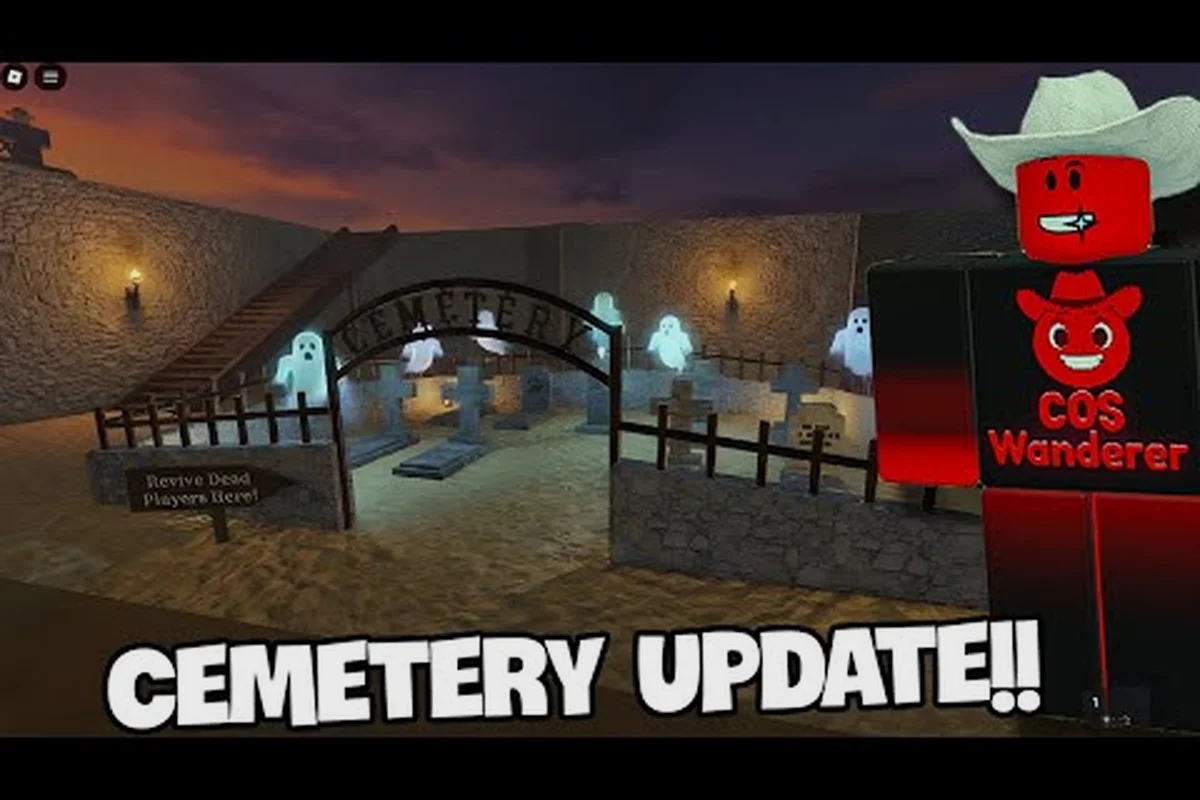
The Dead Rails cemetery update changes revivals, lighting, banks, and seasonal content, making it vital to understand which systems changed before your next run. This guide breaks down the practical details behind the October additions and their impact on combat, exploration, and mode-specific preparation.
Dead Rails Cemetery Update: What Changed in the October Patch
The October 2026 Dead of Night event reshaped several parts of the game, with the cemetery update placing a new emphasis on revivals, nighttime encounters, and currency management. Community field notes report patches arriving on October 20, 24, and 25, so anyone planning around a shop price, enemy statistic, or unlock condition should verify the current build first.
The headline additions reported for Act 1 include the Undertaker Shop, silver coins, and Edison's Revenge. Act 2 also gained an Invasion mode, while the Hollow crossover supplied a Cowboy Hat of the Dead UGC item, a badge, and 10 tickets. These additions connect the cemetery theme to progression instead of treating it as a cosmetic event.
| Update area | Confirmed addition | Practical impact |
|---|---|---|
| Act 1 event content | Undertaker Shop | Adds a new purchasing destination |
| Event currency | Silver coins | Changes how players prepare between runs |
| Weapon content | Edison's Revenge | Expands the available event arsenal |
| Act 2 event content | Invasion mode | Introduces a distinct encounter structure |
| Hollow crossover | Cowboy Hat of the Dead UGC | Adds a collectible cosmetic item |
| Crossover rewards | Badge and 10 tickets | Extends rewards beyond the playable character |
This Dead Rails cemetery update gameplay video is useful for seeing how the new content fits together, although the footage should be treated as a visual reference rather than a permanent rules sheet.
What the revival system changes
The revival flow is the most important part of the Dead Rails cemetery update for groups that want to keep a run going after a player goes down. The core strategic change is that revivals become part of the event's economy and decision-making rather than something players should ignore.
A useful team rule is to spend the revival resource only when the next objective is realistic. If the group lacks ammunition, healing, or a safe route to the objective, reviving immediately can create a second death without changing the outcome. The community-reported silver coin system appears connected to this preparation layer, although exact prices and drop rates are patch-sensitive.
Players should compare the revival flow with the broader Dead Rails game modes overview, because the same action can feel very different in a cooperative event, a standard run, or a more punishing scenario. The key issue is not simply whether a character can return; it is whether returning creates a stronger position than continuing without that player.
Why the rapid patch cadence matters
Dead Rails changes quickly enough that older guides can become unreliable within days. The October 20, 24, and 25 patches are a strong example: a route that worked before the last correction may no longer produce the same encounter pattern, reward, or enemy behavior.
Use a simple verification process before relying on detailed community advice: identify the exact patch build, then confirm the reported route in the current Dead Rails version before treating it as a reliable cemetery strategy. This matters because the October 20, 24, and 25 corrections can alter encounter timing, enemy behavior, and available rewards without changing the basic route itself. A guide made for an earlier build may still describe the correct approach while pointing to outdated drop rates, health values, or lighting conditions.
-
Check the date of any guide or video that lists prices, health values, or drop rates.
-
Compare community reports from more than one recent source when a claim affects a difficult encounter.
-
Test the mechanic in a low-stakes run rather than gambling the first completed attempt on an uncertain route.
-
Record whether the result came from the current build, since older footage may show pre-patch lighting or rewards.
Dead Rails Bank Update: Currency, Shops, and Run Preparation
The Dead Rails bank update is tied closely to the new silver coins and Undertaker Shop, making currency decisions more important during the event. Rather than treating every purchase as an immediate upgrade, players should decide which resources reduce the largest risk in their current run.
The available reference data confirms the existence of the new shop and currency, but it does not provide a durable universal price list. That distinction matters because the community specifically warns that prices, health values, and tier placement can shift between patches. Exact costs should therefore be checked in the live build before committing a large portion of the run's funds.
| Purchase decision | Better reason to buy | Risk of buying too early |
|---|---|---|
| Revival preparation | The group is likely to lose a player | Resources unused before the objective ends |
| Weapon improvement | The new weapon matches the current build | Item has little value in the next biome |
| Consumables | A boss or invasion is confirmed | Supplies expire before the relevant encounter |
| Cosmetic or crossover item | Collection is the main priority | Combat resources become unnecessarily scarce |
Managing silver coins across acts
Silver coins should be treated as event preparation currency, not ordinary loot that must be spent the instant it appears. A practical rule is to reserve enough for the next likely setback, then evaluate purchases after the team learns what Act 2 is likely to demand.
Cooperative groups can reduce uncertainty by assigning one player to track spending while another continues scouting. The scout should note enemies, hazards, and available exits, while the tracker records purchases and the remaining coin reserve. This simple division prevents the group from discovering too late that it has spent everything on a secondary item.
Solo travelers need an even more conservative budget because they cannot revive one another. In that case, the most valuable purchase is usually the one that protects movement, survivability, or access to the next objective. A delayed damage increase may be less useful than an item that prevents a run-ending ambush.
Undertaker Shop purchase order
A sensible order is to separate purchases into three categories: run-ending prevention, objective reliability, and collection value. Buy from the first category before the second, and treat the third as optional unless the run has become safe enough to bank excess currency.
This is also where the broader Dead Rails edison revenge update becomes relevant. Edison's Revenge appears in Act 1 alongside the Undertaker Shop and silver coins, but the weapon's practical value depends on the player's class, aiming habits, and the enemies expected in the next stretch. A strong-looking option can still be a poor purchase if it does not solve an actual problem in the build.
The most reliable approach is to test the weapon during a manageable portion of the run. Observe its handling, reload rhythm, and damage against ordinary enemies before relying on it against a boss. Community reports can help identify whether Edison's Revenge has a distinct role, but personal handling often determines whether it is worth the current price.
Dead Rails Biome Update: Lighting, Navigation, and the Cemetery Theme
The Dead Rails biome update changes how players read familiar spaces, particularly at night. Lighting influences which threats are easy to notice, where safe routes become practical, and how long a group is willing to remain in one area. These details are more consequential when a cemetery event combines exploration with revival decisions.
The Dead of Night presentation adds a thematic layer, but the practical question is whether the revised lighting improves or reduces information. A dark route may look atmospheric while also hiding enemies or environmental hazards, so players who once relied on visible threats may need to slow down and scan more carefully.
| Lighting condition | Likely player decision | Preparation |
|---|---|---|
| Clear entrance | Enter when the group is ready | Check weapon condition and healing |
| Partly obscured path | Slow movement and listen for threats | Keep escape options open |
| Deep shadow | Avoid until the route is checked | Prepare a retreat or alternative path |
| Loot destination | Confirm it is worth the exposure | Set a time limit before leaving safety |
Reading the revised nighttime spaces
The first practical adjustment is to stop treating the center of the screen as the only source of information. Players should listen for movement, watch the edges of the path, and compare the spacing of landmarks with what they remember from earlier runs. The cemetery update makes careful route recognition valuable because the same road may no longer feel as readable under the new lighting.
A useful method is to label three categories while moving: visible hazards, suspected hazards, and safe confirmation points. The first category is acted on immediately, the second receives extra caution, and the third provides a reliable recovery point if the group is surprised.
Keeping navigation efficient
Efficient navigation is not about rushing through every shadow. It is about reducing unnecessary exposure while still finding the objective. Players can use landmarks, visible light sources, and previous route markers to separate uncertainty from actual danger. A group that commits to a known corridor can move faster than one that repeatedly tests the same unclear passage.
For broader location details, the Dead Rails alien biome reference covers several recognizable spaces and routes. Even though the cemetery event changes conditions, checking known landmarks can help players distinguish a temporary lighting effect from a larger Dead Rails biome update that altered navigation itself.
The best test is to approach the same area twice with the same class but a different route. If enemies, hazards, and timing differ because of the path, the new biome may reward alternate approaches. If only visibility changes, preserving the old route while adjusting movement speed is likely the safer option.
Dead Rails Wonder Weapons Update: Edison's Revenge and New Build Options
The Dead Rails wonder weapons update introduces or highlights unusual equipment through the October event, with Edison's Revenge serving as the most clearly identified addition in the available community data. The attraction is obvious: new weapons create new routes through encounters and may change which encounters are worth attempting.
However, the term “wonder weapon” should not be treated as a promise of automatic superiority. A weapon can deal substantial damage and still be weaker in practice if it has a demanding handling style, poor range, or a reload window that conflicts with a fast cemetery encounter.
| Evaluation point | What to test | Why it matters |
|---|---|---|
| Base damage | Performance against a standard enemy | Prevents confusion between a rare and a weak item |
| Handling | Movement, aiming, and attack speed | Reveals the real time-to-kill advantage |
| Reload pressure | Misses and repeated encounters | Shows whether the weapon sustains damage |
| Range | Performance at close and medium distance | Determines which biomes benefit most |
| Build fit | Synergy with the chosen class | Separates strong combinations from merely new gear |
Testing Edison's Revenge
Test Edison's Revenge in stages. Begin with ordinary enemies, record how quickly it clears a predictable group, and then try it during a pressured encounter. The goal is to learn whether its strength comes from raw damage, unusual behavior, or a particular attack pattern that fits the situation better than the current weapon.
Pay attention to the entire exchange rather than the first target. A weapon that quickly defeats one enemy can still be less efficient if it leaves the player exposed between attacks. Conversely, a moderate damage weapon may be the better choice when its speed lets the team avoid damage entirely.
The Dead Rails ray rifle weapon analysis offers a useful benchmark for comparing experimental equipment without treating any single gun as universally dominant. Apply the same criteria to Edison's Revenge: burst damage, control, distance, and consistency matter more than rarity alone.
When a new weapon is worth changing builds
A new weapon is worth adopting immediately when it removes a repeated problem, such as inability to finish enemies before they close the distance. It is less urgent when the current weapon already performs well and the new item is simply a cosmetic change in feel.
A practical build decision test looks like this: if the new weapon cuts the standard-target clear time by even a small margin without increasing reload interruptions, it may solve the core problem in the Dead Rails cemetery update. A stronger case appears when it also preserves health during a full encounter—for example, replacing a weapon that needs two damaging passes with one that defeats an enemy before contact, reducing the risk of a failed nighttime run.
-
Record the current weapon's average time to defeat a standard target.
-
Test the new weapon under similar conditions without changing character or route.
-
Compare health lost, reload interruptions, and travel time.
-
Keep the new weapon only if it improves the full encounter, not merely the damage number.
This method reduces the risk of buying a promising event item and discovering late that it performs poorly in the cemetery's nighttime encounters. A useful check is to compare its actual damage output and reload time against the current weapon, because a stronger damage number may still fail if the weapon forces a pause while a cemetery enemy closes in. Testing during a full night route can expose problems that standard-target trials miss, such as wasted ammunition, missed reload windows, or insufficient damage before contact; the result should be judged by health lost and encounter completion time, not by the item’s appearance in the Dead Rails wonder weapons update.
Dead Rails Nightmare, Scorched Earth, and Edison's Revenge Modes
The event's new modes are better understood as different challenge structures than as isolated boss fights. The Dead Rails nightmare update and the Dead Rails scorched earth update affect the pressure placed on a run, while the Dead Rails edison revenge update adds themed content around the October event.
| Mode-related topic | Confirmed information | Best preparation emphasis |
|---|---|---|
| Nightmare | A mode referenced in the update set | Learn its specific encounter and reward rules |
| Scorched Earth | A mode covered by the current update cycle | Prepare for sustained pressure and route efficiency |
| Edison's Revenge | Added event weapon in Act 1 | Test handling before committing resources |
| Invasion | New Act 2 event mode | Balance firepower against team preparation |
Nightmare and Scorched Earth preparation
The safest preparation for any punishing mode begins with fundamentals. Players need a dependable weapon, a clear route, a recovery plan, and enough awareness of the objective to know when an encounter is not worth forcing. More equipment does not fix poor positioning, and a revival does not recover resources that were spent badly several minutes earlier.
For Dead Rails scorched earth update planning, route efficiency deserves special attention. If the mode rewards sustained performance, every avoidable detour can become more expensive than it appears. The Scorched Earth strategy guide can help establish that foundation, while current in-game information should determine the exact route and encounter changes.
Edison's Revenge and Invasion
Edison's Revenge should be evaluated within a full build rather than purchased solely for novelty. Invasion, meanwhile, is the more significant structural addition because it appears in Act 2 as a distinct mode. Players approaching the event should compare its rules with the Edison's Revenge and Invasion mode guide before assuming that standard preparation transfers unchanged.
The most important distinction is the shape of the challenge. Edison's Revenge appears as a weapon and theme tied to Act 1, whereas Invasion changes what players encounter in Act 2. Treating both as the same type of content can lead to poor shopping decisions and incorrect expectations about revival timing.
Choosing the right preparation for each mode
Use the mode's failure condition to choose your loadout. If the danger is damage over time, prioritize health preservation and escape options. If the danger is a powerful single enemy, bring the strongest reliable damage and enough ammunition to handle an extended attempt. If the danger is navigation, remove weight or delays that slow the group without changing its overall combat power.
Revival resources deserve special care. In Nightmare or Scorched Earth, a premature revival may simply repeat the same failure, while a well-timed revival can restore the group's ability to complete an objective. Communicate the condition clearly: revive only if the group can change the tactical situation, such as by creating space, stopping a priority enemy, or reaching a safer position.
Practical Plan for the Updated Event Run
A complete Dead Rails cemetery update strategy should combine preparation, spending, navigation, and mode selection, with the bank serving as the key checkpoint before a cemetery run. Prioritize repairing or upgrading the locomotive, then use spare cash for a consistent route rather than chasing optional loot that can drain reserves. If the Nightmare biome is active, treat the Scorched Earth route and Wonder Weapons as risk modifiers: read the map, avoid unnecessary encounters, and preserve repair resources for the return trip. For Edison’s Revenge runs, the same plan becomes more urgent because enemy pressure and route timing can turn a manageable detour into a costly failure.
Pre-run checklist
Before starting, decide which mode or act you intend to focus on, check the live patch information, and identify the current class and weapon roles. If playing cooperatively, agree on a spending threshold for silver coins and a clear rule for revivals.
| Preparation stage | Decision to make | Reason it prevents failure |
|---|---|---|
| Before launch | Select class, weapon, and mode | Avoids incompatible preparation |
| Early Act 1 | Identify the Undertaker Shop | Prevents rushed purchases |
| Resource phase | Reserve silver coins | Protects revival and recovery options |
| Route phase | Mark safe and uncertain paths | Reduces ambush losses |
| Act 2 transition | Check Invasion requirements | Prevents a costly surprise |
| Team crisis | Decide whether to revive | Avoids repeating a failed attempt |
Mid-run decision rules
Use simple thresholds during the run. Buy a weapon when it solves a current problem, not because it is rarer. Use a revival when the group has a new tactical angle, not merely because a teammate is down. Enter shadows only after the next safe point has been identified, and consider changing the route if the environment prevents early threat detection.
When a guide gives an exact number, compare its date with the current build. Community data can provide a useful starting point, but the fast patch cadence makes live verification essential. This approach also protects strategies involving the silver coin economy, where a stale price can affect the entire purchasing plan.
After the update settles
Once the rapid October patch cycle stabilizes, revisit the strongest community routes and update your notes with verified details. Keep the official or current in-game information as the final authority, then use community experience to interpret difficult encounters and unusual builds.
The best takeaway from the Dead Rails cemetery update is straightforward: revival timing, silver coin spending, nighttime navigation, and weapon testing now matter as a connected system. The new Undertaker Shop and Edison's Revenge add meaningful decisions, but the update rewards players who preserve resources, read the changed environment, and verify patch-sensitive information before committing to a route.
Frequently Asked Questions
What did the Dead Rails cemetery update add?
The October Dead of Night event added the Undertaker Shop, silver coins, Edison's Revenge, and an Act 2 Invasion mode. The Hollow crossover also brought the Cowboy Hat of the Dead UGC item, a badge, and 10 tickets. Exact prices and drop rates may change with later patches.
Is the revival system different in the Dead Rails cemetery update?
The update makes revival preparation more important because the event introduces silver coins and new shopping decisions. A revival is most valuable when it changes the tactical situation or preserves the team's chance to complete an objective. Reviving without a viable recovery plan can repeat the same failure.
Does the Dead Rails bank update change how players should spend currency?
The updated event adds silver coins and the Undertaker Shop, making early spending decisions more consequential. Reserve currency for revival preparation, essential recovery, or a weapon that solves an immediate problem. Since community reports describe prices as patch-sensitive, confirm current values in the live build.
What should players know about the Dead Rails biome update?
The event's nighttime presentation changes how routes and threats are visible, so players should not rely on an old route-reading habit alone. Listen for hazards, identify reliable landmarks, and keep retreat options open. The relevant biome changes may also extend beyond lighting, so verify current encounter layouts.
How do the Dead Rails nightmare update, Scorched Earth changes, and Edison's Revenge relate?
Nightmare and Scorched Earth alter challenge pressure, while Edison's Revenge adds a themed Act 1 weapon. Use stronger preparation for punishing modes, but test Edison's Revenge under realistic conditions before buying it. A rare weapon is valuable only when it improves the player's time-to-kill, control, or overall encounter survival.